Nine principles, and the three I cannot answer for yet
Dr Felix Sukums, a senior lecturer at MUHAS, took our AI4H buildathon cohort through the foundations of digital health this week. I went in expecting a policy briefing. I came out with a checklist I have been running our own project against ever since, and it is not entirely comfortable reading.
The nine principles
The Principles for Digital Development are nine living guidelines for embedding best practice into digital health:
- Understand the existing ecosystem
- Design with people
- Design for inclusion
- Build for sustainability
- Establish people-first data practices
- Create open and transparent practices
- Share, reuse and improve
- Anticipate and mitigate harms
- Use evidence to improve outcomes
The commitment underneath them is stated plainly: at minimum, do no harm; at best, maximise people's agency over their own development.
Read as a list, they are the kind of thing everyone nods at. Read as a test you apply to your own work, they get much sharper. So I applied them.
Where Mama Salama holds up
Mama Salama is our team's entry in the buildathon: a Swahili phone companion for the first three to four weeks after delivery, so a mother can check her own and her baby's danger signs and be told clearly whether to seek care. It runs offline, entirely on the device.
Three principles it answers well.
Design for inclusion. Offline, in Swahili, on a cheap phone the family already owns. Each of those was a decision about who gets left out, not a technical convenience.
Establish people-first data practices. Because the clinical logic and the language understanding live on the phone, her information never leaves it. The most private design was also the one the network conditions forced on us. That is a good accident and I will take it.
Anticipate and mitigate harms. When a case is unclear, the tool errs toward seek care. We settled that early. A triage tool that is wrong in the direction of caution costs a family a trip. Wrong in the other direction costs far more.
The three I cannot answer for yet
Build for sustainability. It is a buildathon project. There is a finale, and past the finale sits a question I do not yet have an answer to: who runs this, who pays for it, and who updates the clinical content when national guidelines change. Prototype-shaped thinking is the default in a competition, and this principle is a direct challenge to it.
Use evidence to improve outcomes. No mother has used this yet. Everything we currently believe about whether it helps is a hypothesis held by six people, none of whom is the user.
Understand the existing ecosystem. This one stung most, because it is first on the list and I had treated it as throat-clearing before the real content. Our tool stands alone. It does not talk to the facility she would be referred to, it does not appear in any register, and it knows nothing about the health system on the other side of its own "seek care" advice. That is not a feature gap. It is an ecosystem gap, and they are different problems with different solutions.
Dr Sukums made the point directly: ecosystem thinking is what advances digital health, including AI. It is the same lesson my health data work taught me from the other end. A pipeline that does not connect to how people actually work produces clean numbers nobody uses.
The wider map
Two other slides are worth keeping.
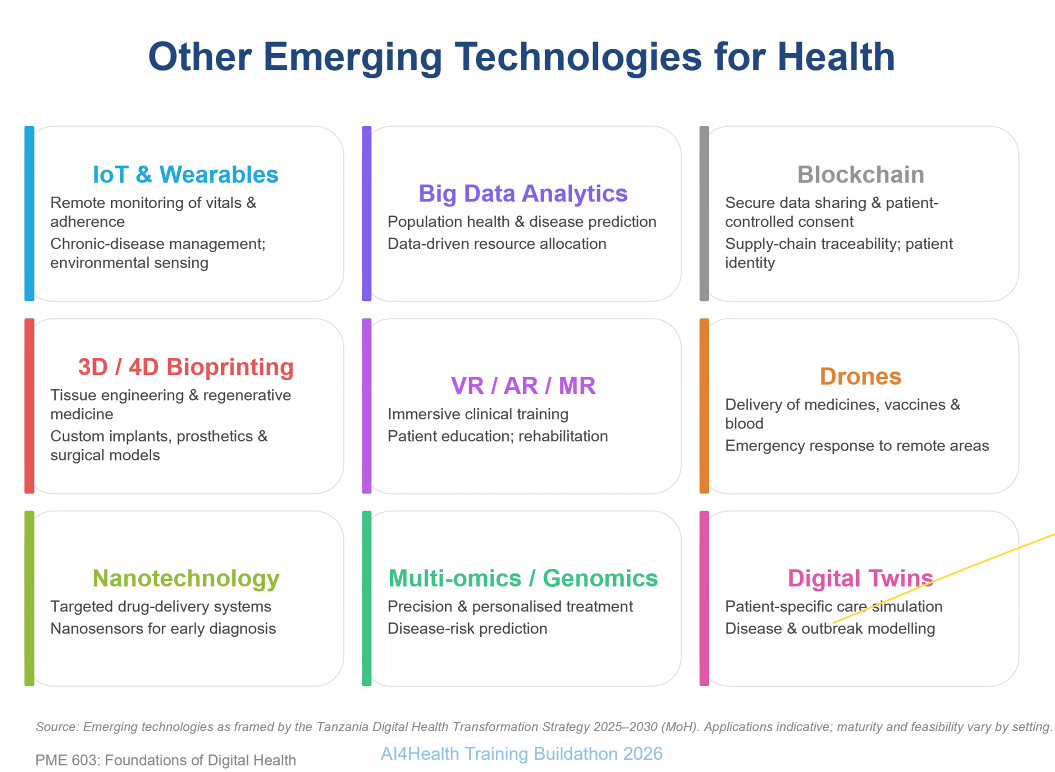
The first is the field beyond AI. It is easy, inside an AI buildathon, to forget that AI is one instrument in a fairly crowded room: IoT and wearables, big data analytics, blockchain, 3D and 4D bioprinting, VR, AR and MR, drones, nanotechnology, multi-omics and genomics, and digital twins. Maturity and feasibility vary enormously by setting, which is the honest caveat usually left off this kind of slide.
The second is the slide I would put in front of anyone building health technology in Tanzania right now: the eleven priorities of the Tanzania Digital Health Transformation Strategy 2025 to 2030.
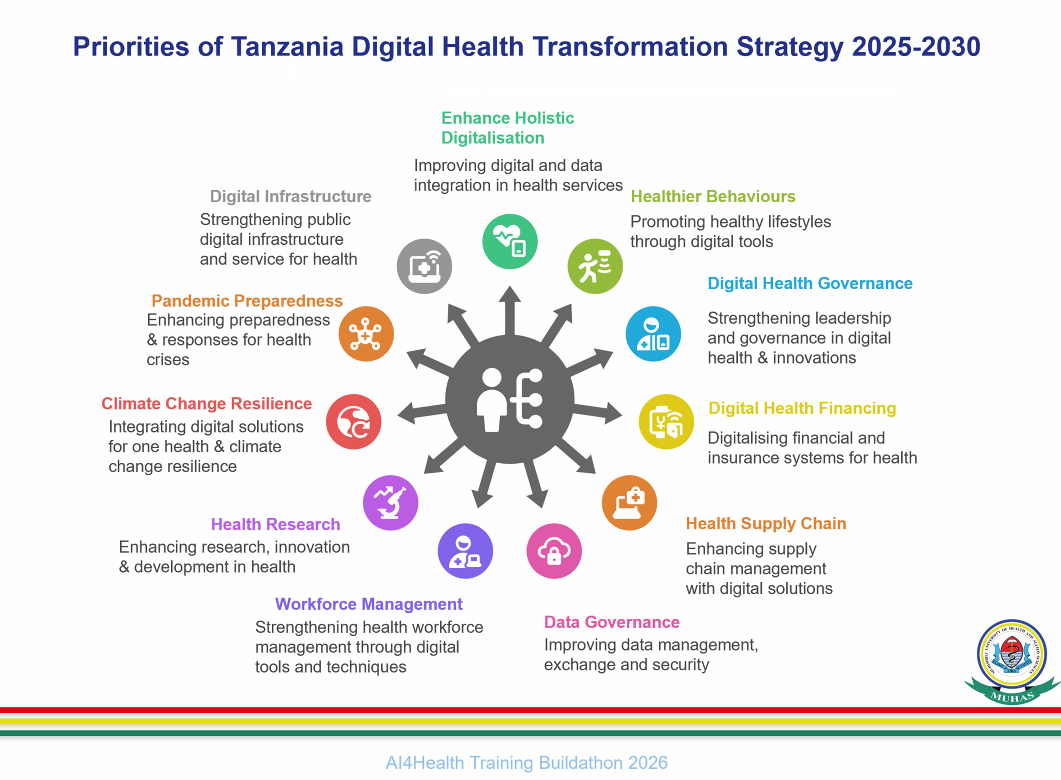
Holistic digitalisation, digital infrastructure, healthier behaviours, pandemic preparedness, digital health governance, climate change resilience, digital health financing, health research, health supply chain, workforce management, and data governance.
I am reading that as a map, not a wish list. It tells you where national attention, and with it funding, integration and adoption, will sit for the next five years. A good idea that falls outside all eleven has a much longer road than a good idea that sits inside one of them.
Mama Salama sits inside healthier behaviours, and inside holistic digitalisation too if we ever solve the referral question. Knowing that changes what I would build next.
What I actually took away
That a checklist is only useful if you are willing to fail it in public.
I could have read the nine principles, agreed with all of them, and carried on exactly as before. Running our own project through them honestly produced three things we cannot currently answer, which is worth considerably more than nine things we can nod at.
Principles for Digital Development: Digital Impact Alliance, 2024, digitalprinciples.org. Emerging technologies and strategic priorities as framed in the Tanzania Digital Health Transformation Strategy 2025 to 2030 (Ministry of Health). With thanks to Dr Felix Sukums, MUHAS, for the session.
1 comment
Noela
"ecosystem thinking is what advances digital health, including AI. It is the same lesson my health data work taught me from the other end. A pipeline that does not connect to how people actually work produces clean numbers nobody uses." What a highlight! I think this whole project is very promising and here is the centre of whether or not this is worth building and doing.How do people actually operate? and how can we deliver value to them in their current systems. In the end of the day people end up choosing things that integrate smoothly and seamlessly in their way of life. I think once test runs of actual users starts it will give more insights and data on what works and what doesn't.